Hitting flaws & fixes.
Recognize the pattern. Understand the adjustment. Practice it, then test it in games.
All hitting flaws
 Practice demonstration: Wall Drill
Lunging
The hitter's head and torso drift excessively toward the pitcher before rotation, reducing adjustability, balance, and barrel accuracy.
 Practice demonstration: Outside Angle Toss
Pulling Off
The front shoulder, head, or torso leaves the ball early, causing the barrel to cut across the zone and reducing plate coverage.
 Practice demonstration: Balance Beam
Stepping in the Bucket
The stride moves away from the plate, opening the front side early and creating difficulty covering the outer half.
 Practice demonstration: Back Hip Load Tee
Collapsing the Backside
The rear hip, knee, or shoulder loses posture and drops underneath the swing, often producing an excessively uphill path and inconsistent contact.
 Practice demonstration: Extension and Direction Drill
Rolling Over
The top hand turns over before or through contact, redirecting the barrel across the ball and producing weak pull-side ground balls.
 Practice demonstration: Back Net Constraint Tee
Bat Drag
The rear elbow and barrel trail behind the rotating torso, creating a long, late, hand-dominated delivery.
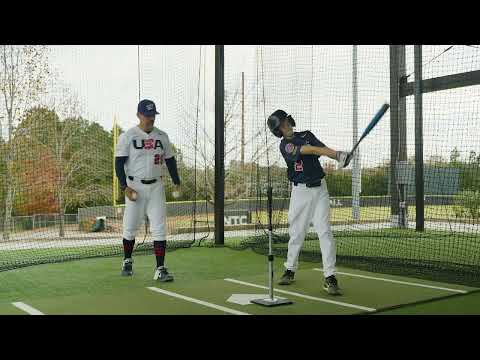 Practice demonstration: Separation Progression Tee
Poor Separation
The lower body, torso, and hands move together without creating stretch between the pelvis and upper body at launch.
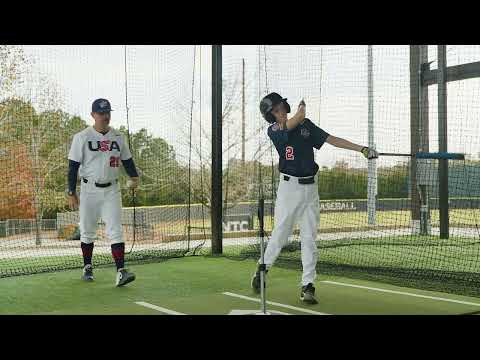 Practice demonstration: 1-2-3 Walk-Up Rhythm Tee
Timing Problems
The hitter does not consistently arrive in a balanced launch position early enough to recognize, adjust to, and attack the pitch.
- Practice demonstration: Back Net Constraint Tee
Improper Barrel Path
The barrel enters, travels through, or exits the hitting zone inefficiently, reducing adjustability and quality contact across pitch locations.
 Practice demonstration: Hitting Principles: Contact Point Awareness
Improper Contact Point
The hitter consistently meets the ball too far out front or too deep in the zone, mistiming the barrel’s arrival at the point of contact and reducing power and adjustability.
Hitting is 50% from the neck up and 50% from the neck down.
Mechanics are important. So are the four things a lot of hitters never train:
Want this diagnosed on your hitter?
Recognizing a pattern is a start. An Initial Assessment helps identify what is actually holding your hitter back and what to work on first.
Send a short form
Tell me your hitter's age, level and what you want to improve.
I call you
We talk through where your hitter is and whether this is the right fit.
Initial Assessment
One hour. You leave knowing what's working, what's in the way and what comes first.
Lessons take place in Westbury and across Long Island. Availability is shared when you inquire.