Why Your Hitter Looks Great in Batting Practice but Struggles in Games
Your hitter does not need to become better at batting practice. The goal is to build a swing, approach, and decision-making process that survive when the game speeds up.
In this article7 sections · tap to jump
Your hitter is driving the ball all over the cage. The swing looks loose. The timing looks easy. Confidence is high.
Then the game starts—and that same hitter is late on fastballs, chasing breaking balls, rolling over pitches, or taking the one pitch he should have attacked.
Parents usually assume one of two things: the swing suddenly broke, or the player is nervous.
Sometimes mechanics or confidence are involved. But the more honest answer is usually this:
Batting practice prepared the player to swing. It did not prepare the player to hit.
As a Long Island hitting coach, I see this constantly. The hitter does not need to become better at batting practice. The hitter needs a movement, approach, and decision-making process that can survive when the game becomes unpredictable.
That is the difference between building a cage hitter and developing a real hitter.
The Cage Gives the Hitter Answers. The Game Asks Questions.
Traditional batting practice removes most of the decisions that make hitting difficult.
The player knows a pitch is coming. It will probably be a strike. The speed is familiar. The rhythm is repeated. If the swing is bad, another pitch arrives a few seconds later.
A real at-bat offers none of those guarantees.
| In batting practice | In a game |
|---|---|
| A strike is expected | The hitter must decide ball or strike |
| Speed and rhythm are repeated | Speed and timing can change every pitch |
| Location is usually controlled | The pitcher attacks different areas |
| There is no meaningful count | The count changes the plan |
| A mistake is immediately replaced | One decision can determine the at-bat |
| The hitter can think only about the swing | The hitter must see, decide, move, and adjust |
There is nothing wrong with tee work, front toss, or controlled batting practice. Those environments are necessary when a player is learning a movement.
But they are the beginning of development—not the finish line.
Cage success proves that a hitter can execute a known task. Game success requires the hitter to solve an unknown one.
Where Game Transfer Usually Breaks Down

1. The Hitter Treats Every Pitch Like a Strike
In most batting practice, the hitter is rewarded for swinging. Takes feel like wasted reps, so the player learns to expect a hittable pitch every time the ball is released.
That habit becomes expensive in games.
The hitter starts reacting to every pitch instead of hunting one. The strike zone expands. Breaking balls below the zone look tempting. Fastballs on the edges create defensive swings early in the count.
You cannot hit anything when you are trying to hit everything.
A game-ready hitter understands the difference between a strike and a pitch that can be driven. The count, situation, pitcher, and hitter's strengths all influence that decision.
Taking a pitch outside the plan is not passive. It is disciplined aggression.
2. The Hitter Is Timed to the Coach—not the Pitcher
Many hitters develop excellent batting-practice timing because the coach repeats the same delivery and release rhythm.
Then they face a pitcher with a leg kick, quick slide step, hesitation, higher velocity, or usable off-speed pitch. Their normal rhythm disappears.
Timing begins before the swing. The hitter must gather information from the pitcher, begin the move early enough, and control the forward move while the pitch is being recognized.
When that process starts late, everything rushes:
- The stride becomes faster.
- Posture changes.
- The hands take over.
- The barrel enters the zone late.
- The hitter starts guessing instead of seeing.
When it starts too early, the player may drift forward, lose the coil, or reach for off-speed pitches.
The problem may look mechanical at contact, but the breakdown started with how the hitter prepared to move.
3. The Swing Only Works Under Perfect Conditions
A movement is not truly owned just because it appears during a perfect tee swing.
The real test is whether the hitter can maintain the important checkpoints when timing and location change:
- Can the hitter stay hinged and athletic?
- Can the coil remain controlled during the forward move?
- Can the lower half begin the rotation without the shoulders flying open?
- Can the front side stabilize the body?
- Can the barrel adjust to different contact points?
The game does not create flaws out of nowhere. It exposes movements that were not stable enough yet.
This is why I compare controlled swings with competitive swings. A hitter may produce good Blast Motion numbers during predictable front toss, then lose connection, on-plane efficiency, or adjustability when a decision is added.
The number is not the answer by itself. It helps show us where the movement changed.
For the mechanical framework I use, read The 7 Critical Swing Checkpoints.
4. The Hitter Has No Adjustment Process
Young hitters are often told to "forget about it" after a bad at-bat. Moving on matters—but moving on without learning anything wastes information.
A real hitter should be able to answer:
- What did the pitcher show me?
- Why was I early or late?
- Which pitch did I misread?
- Did I leave my plan or get beat inside it?
- What will I change in the next at-bat?
The best hitters are not perfect. They are better at collecting information and adjusting before the game ends.
That skill has to be coached. It will not appear automatically because a player took more swings.
Is the Problem Mental or Mechanical?
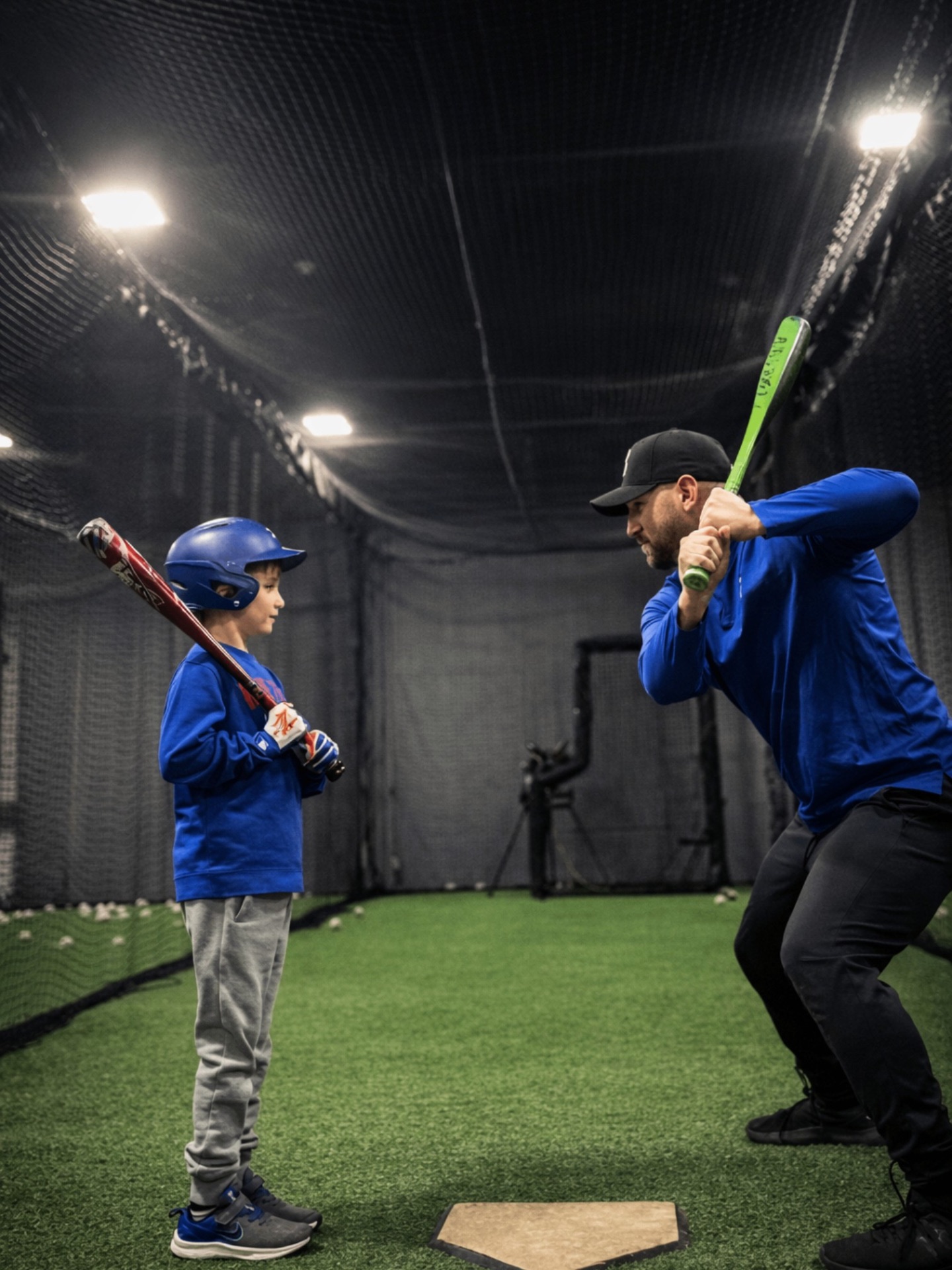
Usually, that question creates a false choice.
Hitting is 50% from the neck down and 50% from the neck up.
The lower half, posture, sequencing, barrel path, and contact position matter. So do vision, pitch recognition, timing, count awareness, situational IQ, and confidence.
They influence each other.
A hitter without a plan feels rushed. A rushed hitter loses the movement. A hitter who does not trust the movement becomes hesitant. Hesitation makes the timing worse.
That does not mean the player "cannot handle pressure." It means the game exposed a skill that training has not fully developed yet.
Confidence does not come from repeatedly telling a player to believe. It comes from preparation. When hitters have already faced difficult decisions, changing speeds, uncomfortable counts, and failure during training, the game stops feeling unfamiliar.
What Training That Translates to Game Day Looks Like

Good training does not eliminate controlled work. It gives controlled work a purpose and then progresses beyond it.
Build the Movement
Start with the tee, dry work, or controlled toss when the hitter needs to understand a position or pattern. Establish a video and Blast Motion baseline. Identify the first checkpoint that needs attention instead of changing five things at once.
Add Uncertainty
Change speed, height, and location. Force the hitter to adjust the contact point instead of repeating one comfortable swing. The hitter should not know exactly where every pitch is going.
Add Decisions
Mix balls and strikes. Train zone awareness, pitch recognition, count leverage, hunt zones, and two-strike protection.
A correct take counts as a successful rep. If every successful rep requires a swing, the hitter is not learning how to control the strike zone.
Create At-Bats, Not Endless Rounds
Give the hitter a count and a situation. Make the player compete with a plan. Track quality at-bats, not just balls that fall for hits.
A hard lineout, walk, productive out, or two-strike battle can reveal more development than a weak single. Read Defining a Quality At-Bat for the standard I use.
Review the Decision
After the rep, ask what the hitter saw and why the decision was made. Do not immediately give the answer. The goal is to develop a player who can recognize the problem and make an adjustment independently.
That is how training creates an intelligent, confident, adaptable hitter—not a player who needs a coach to rescue every at-bat.
What Parents Should Watch on Game Day
Do not evaluate the hitter only by hits and batting average. Watch the process underneath the result.
- Did the hitter start the move on time?
- Was there a clear pitch or area being hunted?
- Were the swings aggressive inside the plan—or defensive at everything?
- Did the hitter recognize how the pitcher was attacking?
- Was an adjustment made during the next at-bat?
- Was it a quality at-bat even if the result was an out?
A hitter can do everything right and still make an out. A hitter can also get a hit after making a poor decision.
Development is found in the quality of the process repeated over time.
Why Random Drills Do Not Fix Game Struggles
The same result can come from completely different causes.
A popup may come from a late move, incorrect contact point, poor posture, an unstable front side, or a bat the player cannot control. A rollover may be a timing problem—not "rolling the hands." A called third strike may come from poor pitch recognition, a bad plan, or fear of making a mistake.
That is why prescribing a drill from the result alone is guessing.
The correct order is simple:
- Identify what happened.
- Review the movement and decision that produced it.
- Find the first breakdown.
- Choose the drill or constraint that addresses that cause.
- Retest the change under game-like conditions.
Diagnose first. Train second. Test the transfer.
Frequently Asked Questions
Why does my hitter perform better in practice than in games?
Practice may be removing the timing, decision-making, changing speeds, pitch recognition, and pressure present in real at-bats. The hitter has learned to execute in a predictable environment but has not yet learned to adapt when the environment changes.
Does my hitter need more confidence?
Possibly—but confidence is often a result of preparation. A hitter becomes more confident by developing a clear plan, trusting a repeatable movement, facing difficult situations in training, and learning how to adjust after failure.
Can Blast Motion diagnose the entire problem?
No single metric can diagnose a hitter. Blast Motion gives objective information about bat speed, on-plane efficiency, rotational acceleration, connection, attack angle, and time to contact. That data must be combined with video, movement analysis, pitch decisions, and the player's goals.
Where does Coach Steve provide private hitting instruction?
Coach Steve provides private baseball hitting lessons in Westbury, New York, for youth, middle-school, and high-school players across Long Island. Every player starts with an initial assessment before a development plan is recommended.
THE NEXT STEP
WANT THIS DIAGNOSED ON YOUR HITTER?
Your hitter probably doesn’t need more random swings. They need to know what they’re actually trying to fix.
Start with an Initial Hitting Assessment — video analysis, swing and mechanics evaluation, approach and hitting-IQ review, and a clear development plan.